That giant sunspot that supercharged auroras on Earth? It’s back and may amp up the northern lights with June solar storms.
Old sunspot region AR 13664, now renamed AR 13697, is back. With its re-arrival, can we expect a resurgence of solar activity?
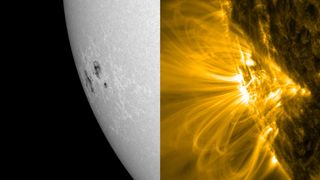
AR 13664 / 13697 rotating back into view, observed by NASA’s Solar Dynamics Observatory. (Image credit: NASA Solar Dynamics Observatory)
Earlier this month, solar active region AR 13664 produced 12 X-class solar flares across six days.
The first batch of flares triggered successive Earth-directed coronal mass ejections (CMEs) — large expulsions of plasma and magnetic field from the sun — resulting in a G5 geomagnetic storm at Earth.
This category of geomagnetic storm, the first since 2003, caused widespread auroras around the world. On May 14, on its final day before rotating behind the western edge of the sun, the active region produced the largest solar flare since September 2017 — clocking in at an X8.79-class.
Two weeks later, the active region has reappeared on the eastern edge of the sun. Now that it’s back — what solar activity can we expect in the coming weeks?
Related: Colossal X-class solar flare suggests return of sunspot group that fueled May’s epic auroras (video)
The sun has an average rotation period of 27 days, providing Earth with a view of a given active region for around two weeks before it rotates over the sun’s western edge. Due to a historical inability to track an active region around the back of the sun, newly visible active regions rotating onto the sun’s eastern edge are given a new active region number. Therefore, with its new arrival back into view, AR 13664 has been renamed AR 13697.
However, in this case, AR 13664 / 13697 was never hidden from view, due to continuous X-ray observations from the European Space Agency’s Solar Orbiter spacecraft, which is currently sitting behind the sun (from our perspective) for the next few months. During its transit across the sun’s backside, the active region slowed down somewhat with the overall frequency of X-class flares dropping dramatically. But with its reappearance, we can begin to assess whether this quieter trend is set to continue.