We say Mars is red, but it isn’t. Not really. It’s more reddish-orange, like rust. That’s no coincidence! It’s covered in extremely fine-grained dust that’s primarily composed of oxides of iron, aka rust. Rusty dust. On the Martian crust. And when there’s a blustery gust it must just bust.
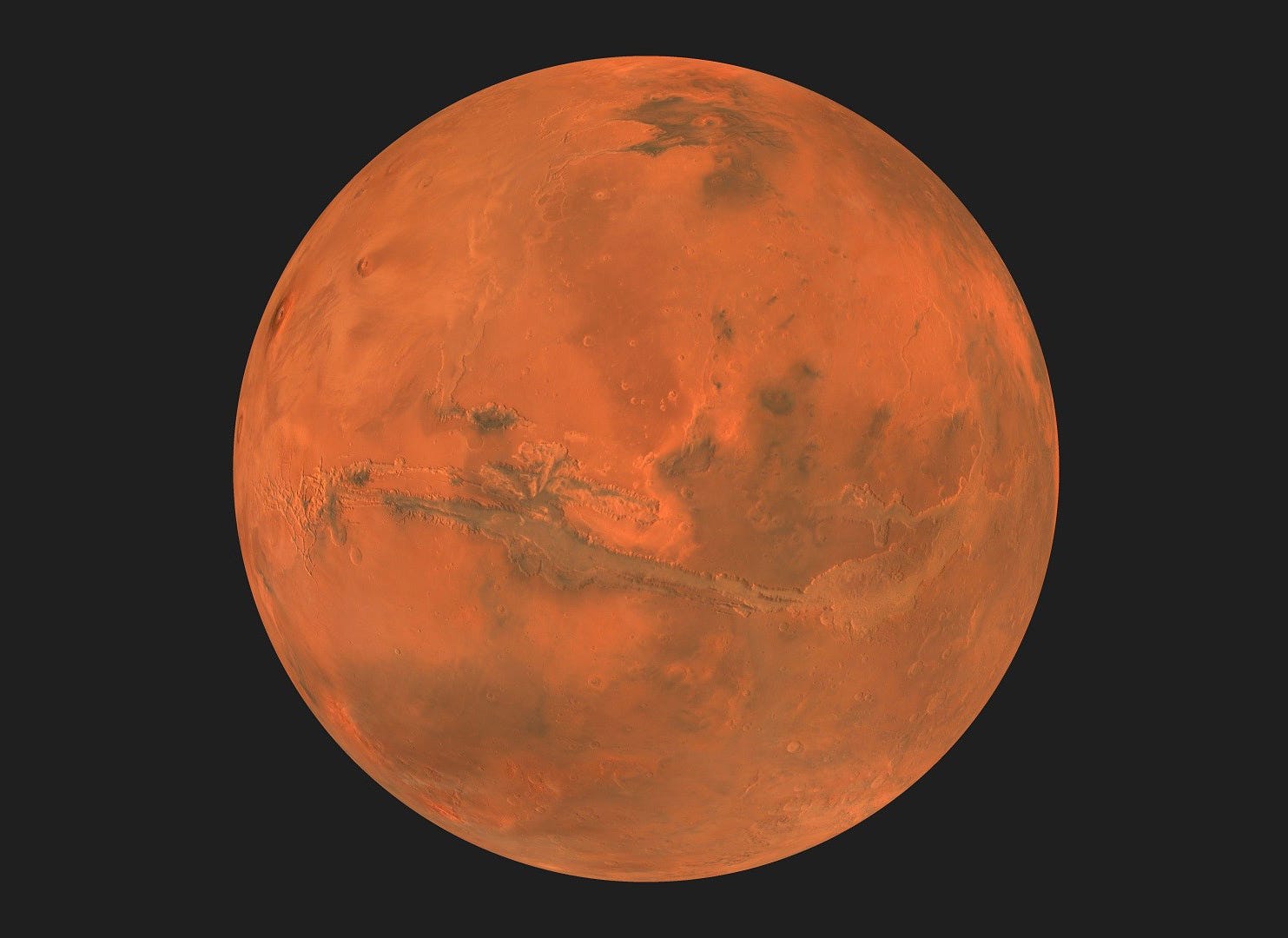
Balancing the colors like the human eye would see them, this Mars Express image shows the planet as it would appear, more or less, if you were actually in high orbit around it. Credit: ESA / DLR / FU Berlin (G. Michael)
Anyway, that’s what gives Mars its overall rusty appearance, but there are other components. A lot of the surface is made of volcanic basalt, which looks gray to the eye, but other minerals reflect different colors, just not as strongly as the dust does, so they’re more subtle.
However, if you have a spacecraft orbiting Mars equipped with a camera and a variety of filters, you can observe the planet at different wavelengths (aka colors) and then use a little photographic trickery to enhance them, you get a much different view.
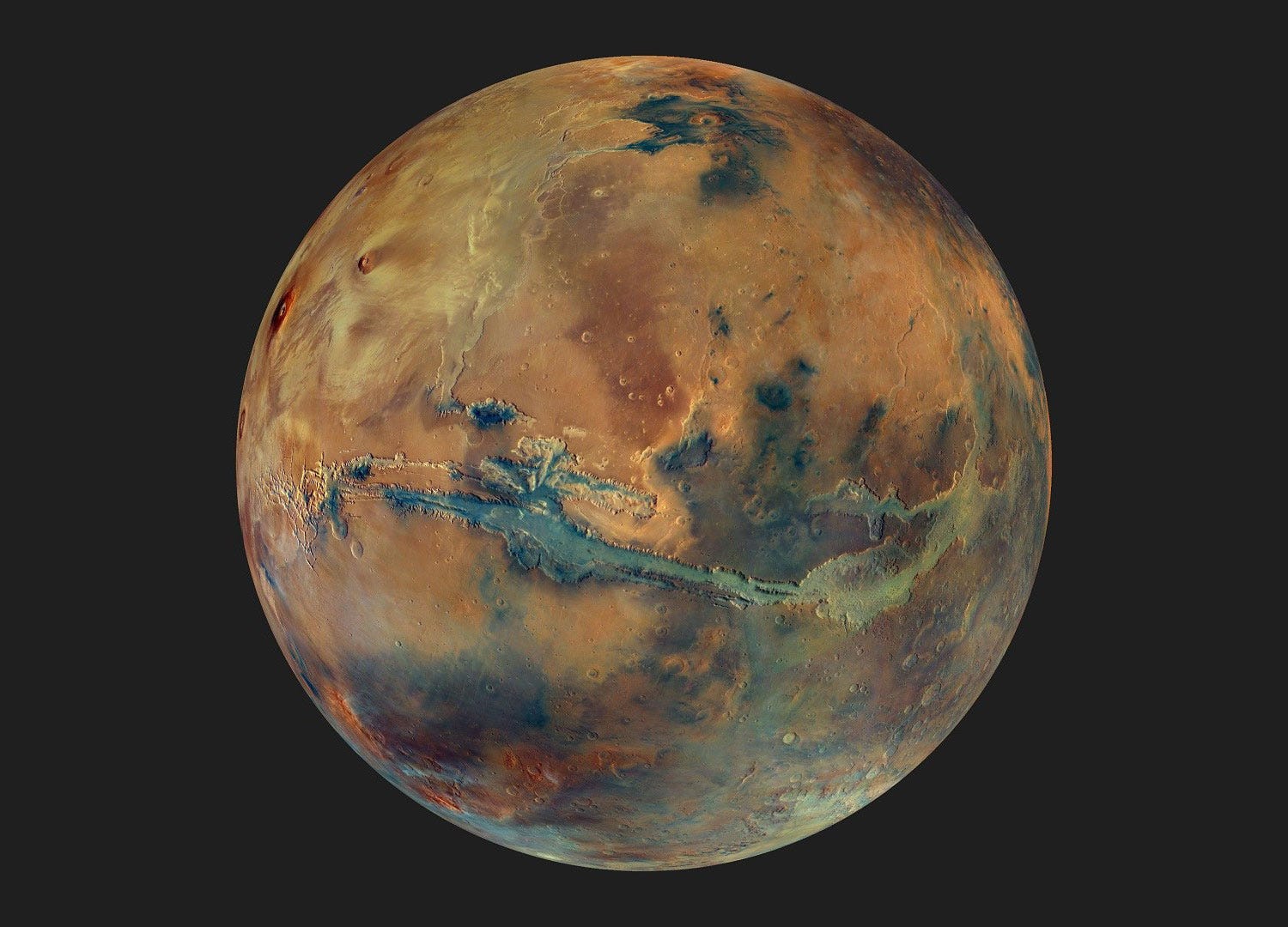
Enhanced-color Mars is a bit trippy. Credit: ESA / DLR / FU Berlin (G. Michael)
Neat! In this shot the green and blue are enhanced, producing a somewhat less eye-aching portrait. The darker areas are dominated by basalt, making it look brown. The big slash across the middle is Valles Marineris, an immense crack in the crust — actually a series of huge cracks that together are longer and wider and deeper than the Grand Canyon by a huge amount. At 4,000 kilometers long — enough to stretch nearly across the entire continental US — it may have formed when the truly staggeringly ginormous volcanoes to its west built up. The crust stretched and cracked, creating the valley.
Valles Marineris looks bluish in this enhanced image, likely due to clouds or fog lying in it. They’re thin, but ramping up the blue light in the image brings them out.