Could Mushrooms Be the Computer Memory of the Future?
Believe it or not, this could actually be a very big breakthrough.
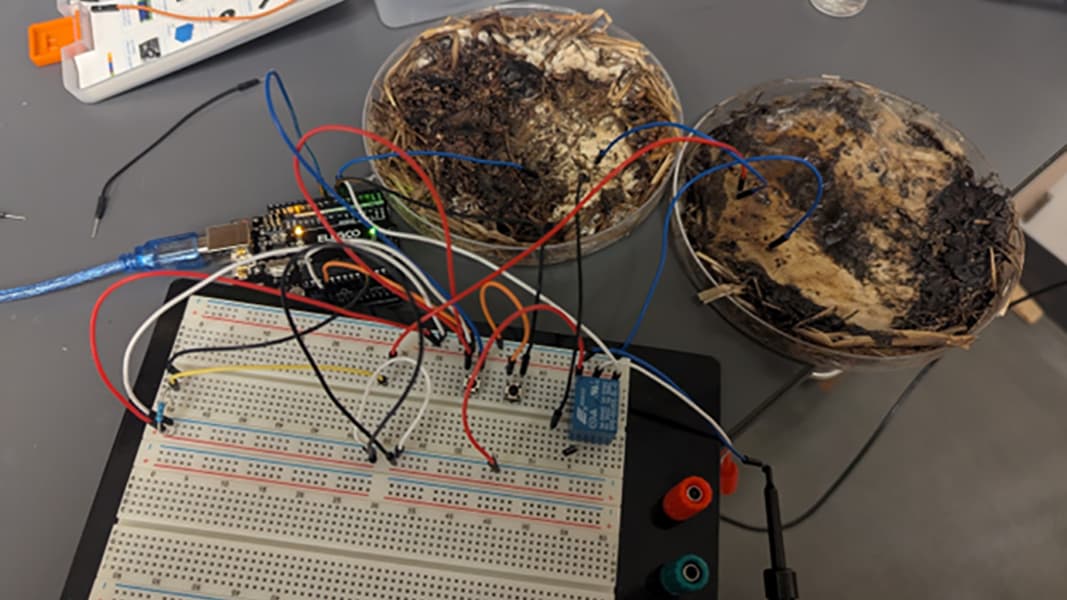
Now, hear us out… Credit: Ohio State University
A new paper published in PLOS One shows that mushrooms can act as the “memristors” required for many next-gen computing applications. Memristors could offer enormous speed boosts over traditional transistor-based computing and, perhaps more importantly, they could unlock the potential of physical “neuromorphic” computing.
Now, we have proof that this important breakthrough is possible in the medium of shiitake mushrooms.
The results come from the team’s growth of mycelial (fungal root) networks in regular petri dishes, which were then partially dried out in the sun. These were then affixed to specially-made electronic circuits, with electrodes connected to different, electronically active portions of the mushroom.
Study lead and Ohio State University researcher John LaRocco says the team “would connect electrical wires and probes at different points on the mushrooms because distinct parts of it have different electrical properties… Depending on the voltage and connectivity, we were seeing different performances.”
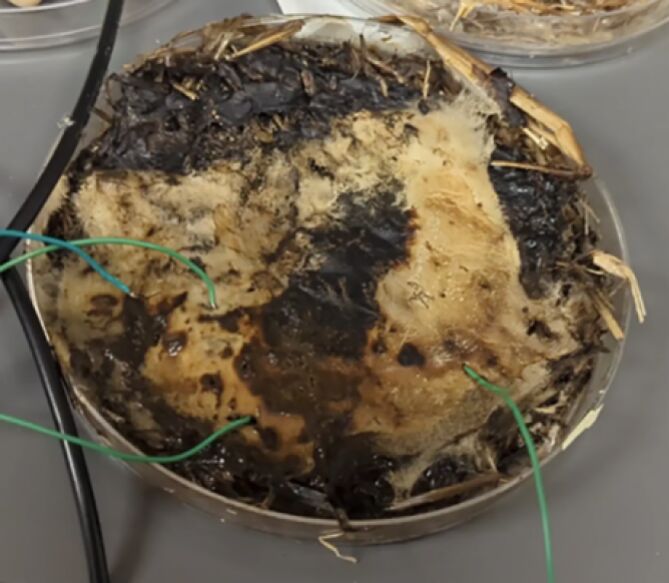
It’s just a starting point, guys. Credit: Ohio State University
They were able to clock their mushroom memristor at 5850 Hz. This is significantly slower than silicon memristors but also a very promising first result, considering how little the team did to tailor their shiitake networks to the task.
These silicon memristors have several problems, most especially that they require extremely rare materials and labor-intensive manufacturing processes.
That’s a particular problem these days, since practical, programmable memristor technology would dramatically change AI, to the point that it could potentially avert the much-prophesied AI bubble. Memristors are the key enabling component of true neuromorphic computers, which means they are critical to lowering the energy cost of AI processing.
Using GPUs to run neural nets is essentially having one type of computer (digital) imagine another (neuromorphic) perform a task. With a physical neuromorphic computer, you would simply have that computer perform the task directly. This leads to orders of magnitude reductions in energy use, immediately fixing AI’s abominable environmental impact and ending its ongoing quest to turn a profit.
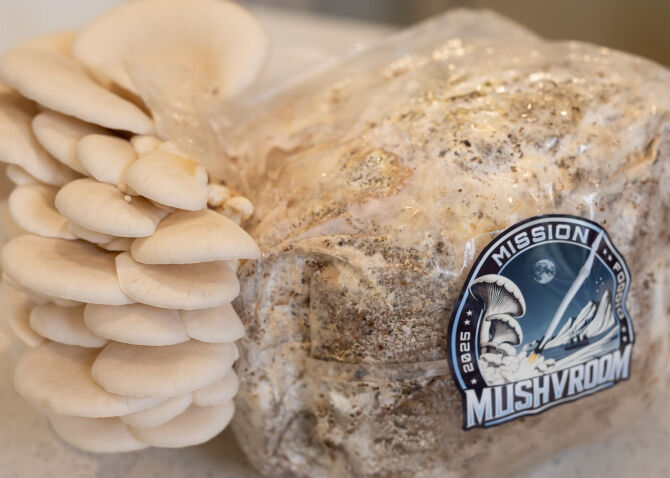
There’s already research ongoing about growing mushrooms in space. The name can change over time, though. Credit: FOODiQ Global
Imagine if a mushroom saved the world economy.
The other interesting thing about mushroom computing is its resilience to radiation, making it perfect for use in orbit. As we’ve recently covered, orbital technologies are currently far too vulnerable to solar storms. Add to that their great ability to grow in zero gravity and their nutritious nature as a food source, and you can understand the excitement behind the nascent fungi-in-space movement.
Of course, this is just a proof of concept, but the very low-tech nature of their setup suggests that this could be a robust, quickly evolving approach. If it was used in concert with advanced gene editing, using specifically engineered fungal networks, it could produce some truly interesting results.
https://www.extremetech.com/science/could-mushrooms-be-the-computer-memory-of-the-future